


Accept Mobile Payments with Carrier Billing
Carrier Billing (also known as Direct Carrier Billing or DCB) enables fast, frictionless mobile payments by charging purchases directly to a customer’s mobile phone bill or prepaid balance. No cards, no wallets, no registrations. Designed for mobile-first use cases where conversion and reach matter most.
Built on trusted mobile payment infrastructure
Connect to all operators with one integration:
one simple implementation provides access to all major mobile network operators and their customers.
Optimized for EU/EEA markets:
Built to support compliant mobile payments across European markets.
Secure and reliable transaction processing:
Platform-level security with real-time transaction monitoring and controls.
Why Carrier Billing matters for merchants
Mobile checkout is the biggest conversion bottleneck. Card entry, redirects, and wallet onboarding create friction, especially on smartphones. Carrier Billing removes these barriers by shifting authentication and billing to the customer’s mobile network operator.
Carrier Billing works seamlessly with:
- Mobile-first checkout experiences
- Digital content and services
- Subscriptions and recurring access
- Micro-transactions and impulse purchases
- Customer segments that prefer mobile-first payment methods

What is Carrier Billing
Carrier Billing is a mobile payment method that allows customers to pay for goods or services by charging the amount directly to their mobile phone bill or deducting it from prepaid mobile credit. It is widely used for digital content, services, and microtransactions, where fast access and smooth checkout are essential.
Authentication and billing are handled by the customer’s Mobile Network Operator (MNO), creating a secure, familiar payment experience that can also support subscriptions and selected physical or on-demand use cases via agent models.
Our Partners









How Carrier Billing works:
DIMOCO transmits the transaction request to the relevant Mobile Network Operator
Built for scale with strong operator relationships
Our Carrier Billing solution connects merchants to Mobile Network Operators through a single, unified payment platform. We handle technical integration, transaction processing, settlement coordination, and operational oversight.
By consolidating operator connectivity and payment processing, we reduce integration complexity and support scalable deployment across markets. Carrier Billing can be offered as a standalone payment method or as part of a broader payment mix.
Supported payment channels
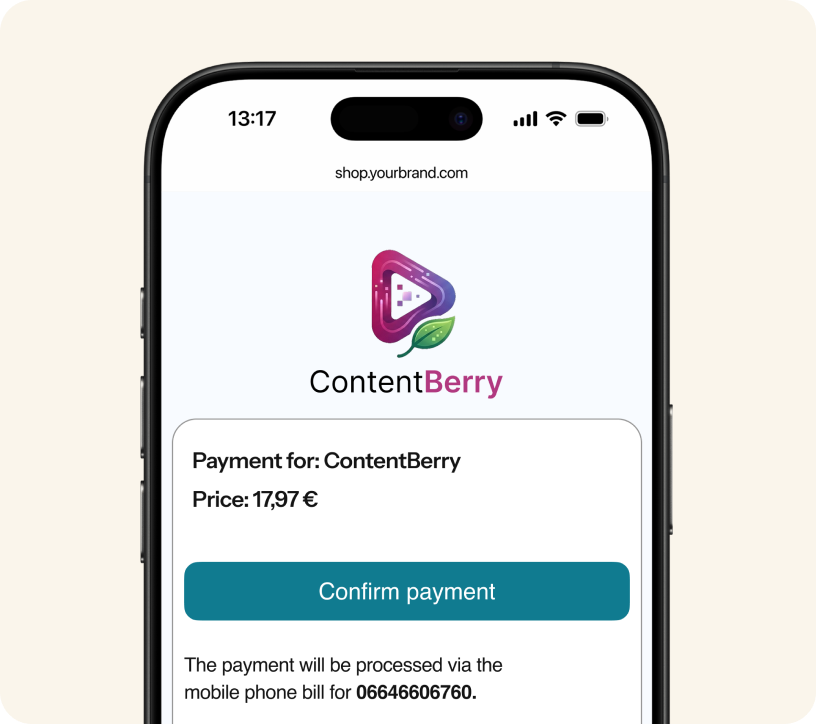
Mobile checkout
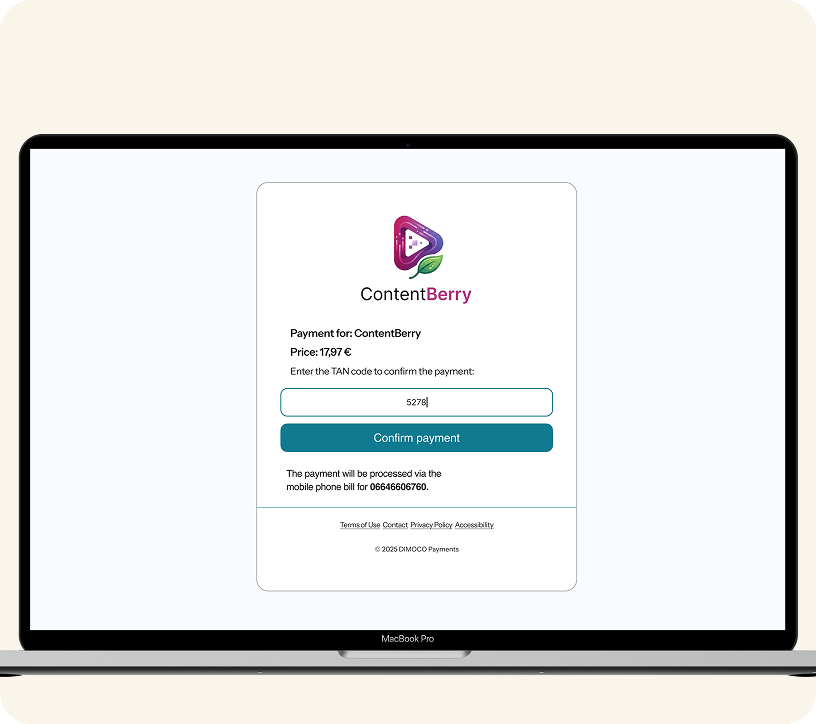
Web checkout
Browser optimized flow with confirmation via TAN verification.
Key Merchants benefits
This streamlined mobile checkout experience reduces friction during the checkout process, resulting in more completed purchases.
Expanded customer reach
It opens up new markets and customer segments, helping businesses expand their customer base. It enables payments for users who prefer alternatives to cards or wallets.
Merchants can enjoy more stable revenue streams and fewer payment-related issues.
Operator-based billing supports reliable settlement cycles and recurring access models.
Operator-managed authentication:
Authentication is handled by Mobile Network Operators, providing a trusted and familiar user experience.
A single Carrier Billing integration and guided onboarding enable efficient activation.
End user benefits
Simple and convenient payments:
Purchases can be completed quickly and easily with only a few steps.
Accessibility payment option:
Available to a wide audience, including users who do not use traditional banking services or credit cards payments.
Trusted and secure experience:
Payments are handled via the mobile network operator without sharing sensitive financial details.
Payment management and operations
Easy integration
Business reporting
Real-time payment monitoring
Customised merchant reports
Refund management
Multi-lingual customer care support
Secure transaction processing
Compliance and risk management
Integrate options
Embedded checkout elements
Pre-built components that integrate into your existing checkout and branding.
API integration (server-to-server)
Full control over checkout and card transaction flows.
Hosted payment flow
Ready-to-use payment pages for rapid deployment with minimal development effort.
Coverage and supported transaction models
Carrier Billing supports:
One-time purchases
Subscriptions and recurring services
Ready to enable Carrier Billing?
Talk to our payments experts and build a Carrier Billing setup designed for mobile conversion, operational control, and scalable growth.
Contact us
Frequently Asked Questions
General Acceptance & Features
Security & Compliance
Pricing, Settlement & Finance
Integration & Management
What types of digital products can be sold using Carrier Billing?
Carrier Billing is primarily used for digital products and services where a fast, mobile-friendly checkout experience is important.
Typical use cases include:
- In-app purchases and virtual goods.
- Gaming payments and micro-transactions.
- Streaming services and digital media subscriptions.
- E-books, online courses, and educational content.
- Cloud services and digital access models.
- Recurring subscriptions and membership services.
Because charges are added directly to the customer’s mobile phone bill or prepaid balance, Carrier Billing is particularly well suited for subscription models, digital services, and low-value mobile purchases.
Available use cases may vary depending on the country and the customer’s Mobile Network Operator.
Can physical goods or offline services be sold via Carrier Billing?
In certain markets, yes.
While Carrier Billing was originally developed for digital content and services, some countries and Mobile Network Operators support additional use cases through specific regulatory frameworks, such as the agent model.
Examples may include:
- Public transport and ticketing
- Mobility services such as scooter rentals
- Parking payments
- EV charging services
- Food delivery and quick commerce
- Vending machine purchases
- Selected low-value physical goods
Availability depends on the country, Mobile Network Operator, and applicable regulatory framework. Supported use cases are reviewed during onboarding to ensure compliance with local requirements and operator policies.
Are there product categories that are typically restricted?
Some categories are typically restricted under traditional Direct Carrier Billing models. Availability may vary by operator, but commonly excluded categories include:
- High-value physical goods, for example, large electronics or furniture
- Banking services or peer-to-peer money transfer tools
Each service category is reviewed individually and must comply with operator policies and local regulations.
Does Carrier Billing support subscriptions and recurring access models?
Yes.
Recurring billing models are supported where permitted by the respective operator and country framework.
This may include weekly, monthly or other recurring intervals.
In which countries is Carrier Billing available?
Can Carrier Billing be offered cross-border?
Yes.
Merchants can be based in one country while customers are billed in other supported European markets via their local Mobile Network Operators.
Availability is determined by the customer’s Mobile Network Operator, not by where the merchant is based.
Can Carrier Billing be used on websites and mobile apps?
Yes.
Direct Carrier Billing can be used across devices, and can also be enabled in retail scenarios via QR-based flows.
The user experience is adapted to each channel to ensure an optimized flow, while the underlying billing process remains consistent.
For specific integration options and technical setup details, please contact our team.
Is Carrier Billing secure?
Yes.
No card numbers or bank account details are shared with merchants during the payment process, which reduces the exposure of sensitive financial information.
Payments are verified through the customer’s Mobile Network Operator, using mechanisms such as one-time passwords (OTPs), SMS confirmations, or operator authentication flows before a charge is approved.
Each transaction requires active customer confirmation. In a TAN flow, customers enter a verification code to authorise the payment. In a Click flow, customers confirm the charge by clicking a confirmation button on the payment page.
Who handles authentication and transaction confirmation?
Authentication and confirmation are handled by the customer’s Mobile Network Operator.
The exact flow depends on country and regulation, but users always see a clear confirmation step before being charged.
What happens if a customer disputes a charge or claims they did not authorise it?
Customers are generally advised to contact the merchant first, as most enquiries relate to the purchased service itself, such as subscriptions, account access, content, cancellations, or billing questions.
Depending on the nature of the case, customers may also contact DIMOCO or their Mobile Network Operator.
If a transaction is disputed, the case is reviewed and investigated in accordance with the applicable procedures and operator requirements.
How are refunds handled with Carrier Billing?
Refund processes depend on country and operator capabilities.
A dedicated dispute management team coordinates complaint handling and refund cases where applicable.
What transaction or spending limits apply?
Under standard Direct Carrier Billing models, a general limit of 50 EUR per transaction and 300 EUR per month per user typically applies.
For services enabled via the agent model, these limits may not apply. However, individual Mobile Network Operators may still impose their own caps depending on the market.
How long does onboarding typically take?
Onboarding time depends on the country, the Mobile Network Operator, the type of service and the applicable regulatory requirements. Depending on the setup, this ranges from a few days to a couple of weeks.