
The term “payment processor” is widely used within the payments industry as a catch all term to describe a variety of functions and roles. The reality is more complicated, and accepting online card payments involves several distinct entities, each performing a specific role in the transaction:
- The payment gateway captures the payment details
- the payment processor manages the technical routing of payment data
- the acquirer handles the merchant’s account and facilitates the transfer of funds
- the issuer is the customer’s bank that provides the card
- and the card scheme, such as Visa or Mastercard, sets the rules and standards for card payments.
They each have their own responsibilities, operational requirements, and fee structures. Understanding the differences between these roles clarifies who is responsible for what during a card transaction and how/why certain decisions are made in the payment chain.,
What does the term “payment processor” actually mean?
Often used as shorthand for the entire payment flow, a payment processor facilitates electronic transactions within the payment chain. It is responsible for the technical routing of transaction information. And in the end, if a payment is approved, they ensure that the transaction data is correctly routed between the merchant, card networks, and banks so that authorized payments can be processed and settled by the relevant parties.
A brief overview of a payment processor’s role:
- securely transmit transaction data to the card network and issuer
- facilitate the authorization request and response flow
- ensure payment messages are accurate and delivered by all parties.
Pure payment processors, which only provide technical processing services, without handling funds or performing regulated payment services, are typically not required to hold a financial license. However, because they handle cardholder data, they should comply with PCI DSS standards.
Find out more about PCI DSS requirements here.
Is a financial license needed to accept payments?
A merchant does not need to have a financial license, but they do need access to a merchant account. A merchant account is a specialized account that enables a business to accept and process credit and debit card payments. The entity that provides and operates the merchant account must hold the appropriate financial license. Approved transactions are settled through the merchant account before funds are transferred to the merchant’s bank account.
How do you get a merchant account?
Merchant accounts are provided and managed by the acquirer, a licensed financial institution, enabling merchants to accept credit and debit card transactions.
The acquirer facilitates card transactions on the merchant’s behalf, ensuring that payments are processed efficiently and securely. After transactions are completed, the acquirer is responsible for settling funds to the merchant. Settlement can occur daily, weekly, or monthly, depending on the terms of the contract. The acquirer also manages the ongoing merchant relationship to ensure compliance and smooth operation. Acquirers must meet specific licensing requirements and are regulated on a country-by-country basis, so merchants need to work with an acquirer that is licensed or authorized to operate in the markets where they do business.
Processing vs acquiring: why the difference matters
| Processing | Acquiring |
|---|---|
| Technical handling | Licensed payment service |
| Authorization messaging | Merchant onboarding |
| Capture | Transaction acceptance |
| Settlement files | Settlement of funds |
In card payments, the roles of processing and acquiring can be handled by the one company or by two distinct entities. However, it is important to note that whether the functions are combined or separated, their core responsibilities remain unchanged. Processing covers the technical aspects and authorization messaging, while acquiring focuses on payment service provision and merchant onboarding.
The card payment chain at a glance
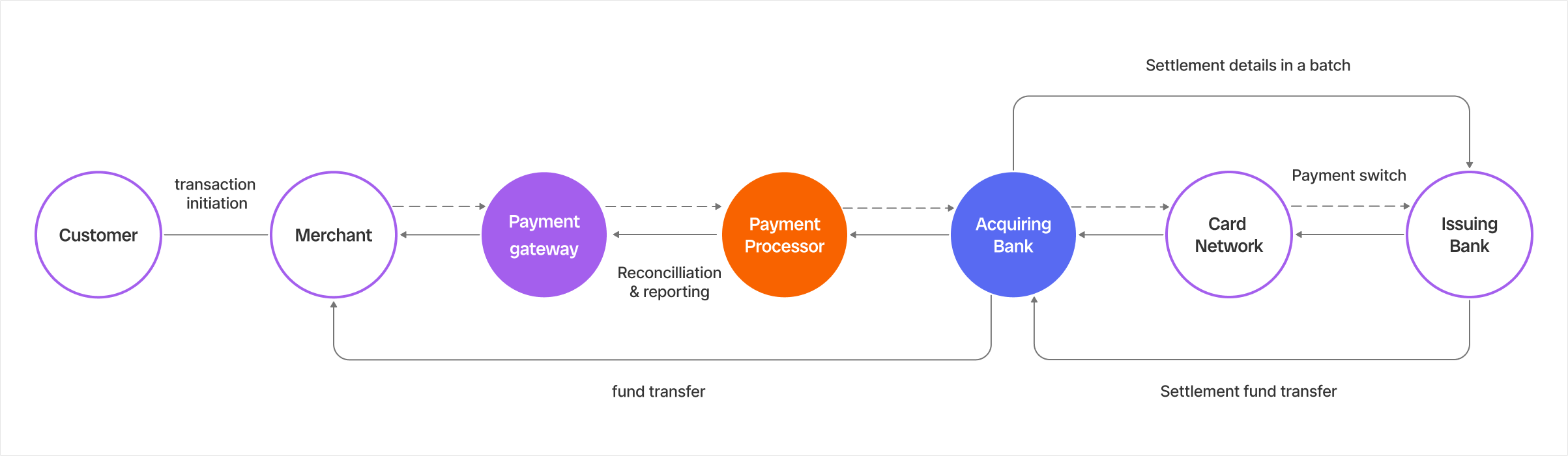
The merchant’s role
This is the easiest role to define. The merchant owns the customer relationship, from pricing, terms and promotions to order fulfilment, customer service, and refunds. They choose what to sell and define their target market. To put it simply, the merchant is responsible for the commercial transaction and is the point of contact for the customers.
What is a payment gateway?
In layman’s terms, a payment gateway is the digital version of a physical point of sale. Its role is to securely transmit payment information between the customer, merchant, and acquirer and its processor to enable card transactions. As payment gateways work with sensitive data, they must comply with PCI DSS requirements and maintain security standards.
The roles of card schemes and issuers
Card schemes provide the network infrastructure and facilitate communication between acquirers and issuers. They ensure that transactions are transmitted securely and consistently across the network.
Issuers – the clue is in the name – are financial institutions, typically banks, that issue credit and debit cards to their customers. When a purchase is made, the issuer is responsible for deciding whether the transaction should be approved or declined.
To make this decision, the issuer looks at:
- The availability of funds/credit
- The status of the card account
- Fraud and risk indicators
- Security and authentication requirements
The issuer is typically responsible for the final authorisation decision. Depending on the results, the issuer will either approve or decline the payment and send the response back through the card scheme network.
Understanding the different roles is important as responsibility within the payment chain depends on where an issue occurs. For example, a declined transaction may result from merchant controls, processor or acquirer checks, or an issuer’s authorization decision.
Who is responsible when something goes wrong?
The customer pays but the product doesn’t arrive.
The merchant is responsible for the selling, delivery and quality of the product. If it does not arrive, the merchant is responsible.
A customer enters their card details correctly, but the payment is declined.
A declined transaction is often based on the decision of the issuer. The transaction goes through checks beforehand; however, it is generally the issuer who makes the final decision.
A customer pays but the funds do not go through
The acquirer is responsible for processing settlement and transferring funds to the merchant.
A customer wants a refund
In most cases it is up to the merchant to approve and initiate a refund request.
Payment not being processed
This is typically a payment processing issue related to the routing the transaction through the network.
What have we learnt?
The term “payment processor” is often used as a convenient shortcut. But behind the scenes merchants, gateways, processors, acquirers, issuers, and card schemes are all working together to make it possible. To learn more about how card payments work and the key players involved, explore our guide to card payments in the EU. So, the next time you tap “Pay Now,” you’ll know far more is happening than meets the eye.
Where does DIMOCO fit in the payment chain?
DIMOCO acts as an all-in-one solution, that combines gateway, processing, and acquiring services with one integration for merchants. This enables merchants to simplify their payments setup, reduce operational complexity and have transparency over the entire transaction lifecycle.
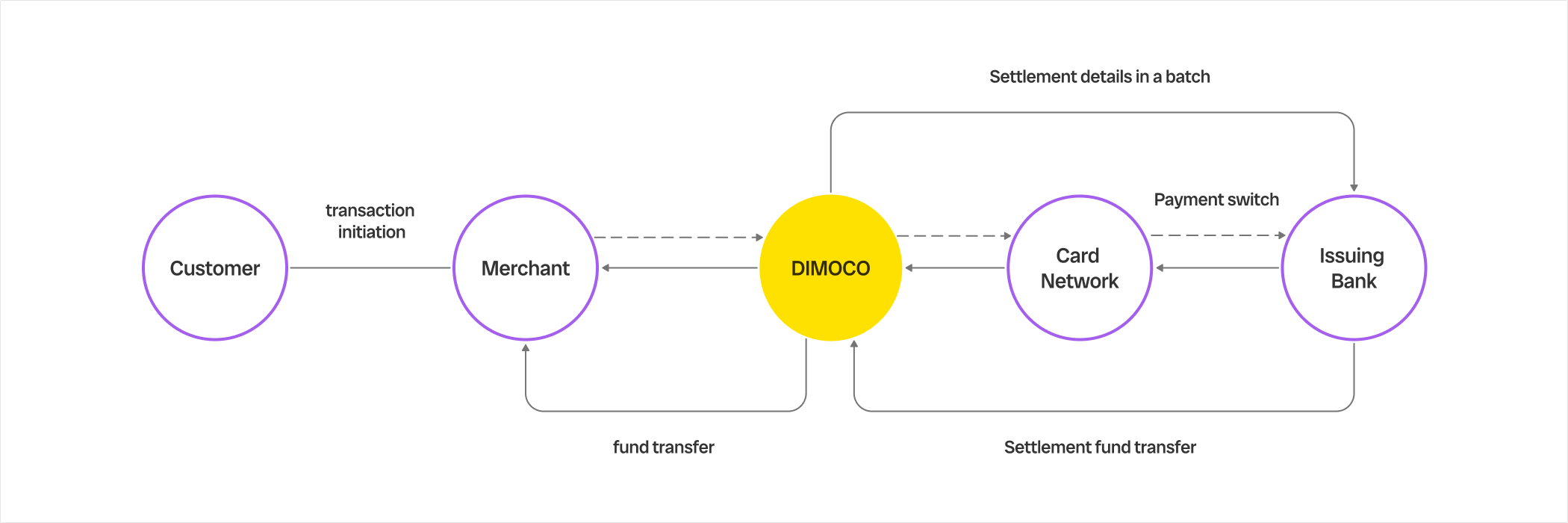
As a regulated financial institution licensed by the Austrian Financial Market Authority (FMA) and certified according to the PCI DSS security standard, and principal member of Mastercard and Visa, DIMOCO meets strict regulatory and security requirements. Merchants can therefore rely on a payment partner that delivers secure, compliant, and reliable online card payment acceptance. More information on DIMOCO’s online card processing capabilities can be found here.